
Cuba advance passenger information
D'Viajeros for families and children
A practical guide for families traveling to Cuba: one D'Viajeros per person, who completes a child's form, passports, medical insurance and customs with kids.
16 min read
Traveling to Cuba as a family is a joy, but the D'Viajeros requirement confuses many parents and grandparents. The golden rule is simple: every traveler needs their own declaration, whatever their age. A baby of a few months, a seven-year-old child or a grandparent joining the group all have to appear with their individual D'Viajeros form and their own QR code on arrival.
In brief: the D'Viajeros is individual and free. A responsible adult can complete a minor's declaration, but each child needs their own, with their passport, their QR code and their customs and health section. Download and print every QR before you leave.
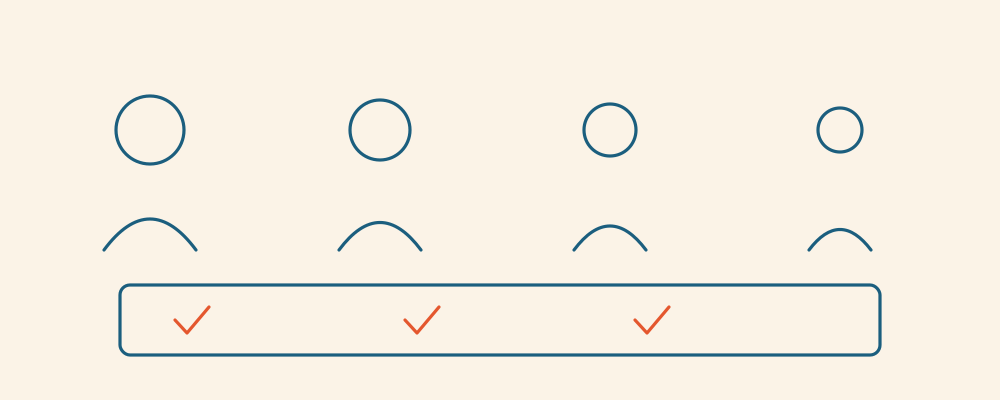
One declaration per traveler, no exceptions
The most common family mistake is to assume a single form covers the whole group. It does not. The D'Viajeros is Cuba's Advance Passenger Information, an individual digital document. Every person crossing the border, whether adult, teenager, child or infant, has their own record in the Immigration, Customs and Public Health system.
That means a family of four will present four declarations and four QR codes at the arrival checkpoints. There is no "family" form and no box to add companions inside a single declaration.
- Babies and newborns also need their D'Viajeros, even if they travel in arms.
- Children and teenagers with their own passport are declared separately.
- Grandparents or other adults in the group each complete their own.
- You cannot "group" several minors under one adult's declaration.
In short: count the people on the trip and you have the exact number of declarations to prepare.
Who can complete a child's declaration
A child does not fill in their own form, of course. The rules allow a responsible adult to complete the declaration on their behalf: usually a parent or legal guardian. That adult enters the child's details exactly as they appear on the child's passport and answers for them in the customs and health sections.
The same adult does not have to complete every declaration in the group, but it is often the most practical approach: one person then controls all the data, all the QR codes and all the deadlines.
Worth knowing: the adult completing a minor's declaration must use the child's document, not their own. The name and passport number have to match the passport the child will present at the desk.
In short: a responsible adult completes each minor's declaration, always with the details from the child's passport.
Each child's own passport
In almost every case, each child travels on their own passport. The old practice of adding children to a parent's passport is gone: today every minor needs their individual document to fly and to enter Cuba.
That passport is the basis of their D'Viajeros. Before you start, gather all the family's documents and keep at hand:
- Each adult's passport, valid.
- Each child's passport, also valid.
- The details of the flight that enters Cuba (number, date and arrival airport).
- The address where you will stay on the island, the same for everyone if you stay together.
- Each person's travel medical insurance policy.
In short: no child's passport means no child's D'Viajeros; gather every document before you sit down to fill in the forms.
How to manage several declarations on one trip
Completing four or five forms in a row may sound tedious, but a little method makes it far easier. The declaration is completed on the official portal and can be validated up to 48 hours before arrival, so set aside a quiet moment once you have all the flight details.
A sensible order of work for the family:
- Start with the adults, who usually have their details closest to hand.
- Move on to the minors, one by one, using each child's passport.
- Repeat the shared details on each form: flight, date and address of stay.
- Check name and passport number before validating each form.
- Save each QR code as soon as it is generated, labeled with the person's name.
If you want the field-by-field detail, we have a dedicated guide on how to fill the D'Viajeros form that applies equally to an adult's declaration and a minor's.
In short: work in one batch, with every passport in front of you, and repeat the shared details carefully on each declaration.
Several QR codes in one family: download them all
When you validate each form, the system generates a distinct QR code. On a family trip you will end up with as many QR codes as people, and at the Cuban airport you will be asked for each traveler's code separately at the checkpoints.
The advice is clear: download and print every QR code before you leave home. Internet access in Cuba is limited and expensive, and you do not want to rely on your phone or airport Wi-Fi to show your small child's QR.
- Download each QR to your phone (screenshot or PDF) and save it to the cloud.
- Print a paper copy of each one, in case a phone runs out of battery.
- Check that the printed QR looks sharp and complete.
To understand what that code is and how it is used, read our guide to the D'Viajeros QR code.
Worth knowing: one QR does not work for two people. If you show the wrong code at the checkpoint, the officer will see someone else's details. That is why it pays to keep them clearly labeled.
In short: one QR per person, downloaded and printed, is the safe way to arrive stress-free with children.
Organize the QR codes by person
With several QR codes in play, order is everything. A method that works well is to prepare, for each family member, a small set with their passport and their QR code together.
Practical ideas so you do not get confused at the desk:
- Name each file on your phone with the traveler's name: "QR-Ana", "QR-Lucas".
- Print each QR on its own sheet and write the name at the top by hand.
- Use a sleeve or folder per person, with passport and QR inside.
- If one adult carries every document, order them in the sequence the family will clear the checkpoint.
That way, when the officer asks for "the child's", you know exactly which one to show without scrolling through screens.
In short: pair each person's passport and QR and label them; the order saves you nerves in the line.
Customs with children: medicines, formula and gifts
The customs part of the D'Viajeros applies to minors too, and on family trips it often raises the most questions. When you declare for each child, keep in mind what the group is really carrying in its luggage.
Common situations worth declaring honestly:
- Medicines: the child's (and the family's) are best carried in their original packaging, with a prescription if possible, especially in larger quantities.
- Formula and baby food: it is normal to carry these for an infant; declare what applies if the form asks.
- Gifts: clothing, shoes, toiletries or electronics you bring for relatives on the island belong in the customs declaration.
- Cash: if the group carries foreign currency above the threshold, it must be declared; note that the total is what counts, not "per head".
Cuba has its own rules on what may be brought in and in what quantity, and they change fairly often. For the detail, lean on our guide to Cuba customs and cash declaration and always confirm the current limits with the General Customs of the Republic.
Worth knowing: cards issued by US banks do not work in Cuba, so many families travel with cash. Split and declare it sensibly, and treat no threshold as fixed: confirm it before you travel.
In short: honestly declare medicines, baby formula, gifts and cash; the child's customs is the responsibility of the accompanying adult.
Table: traveler type, own declaration and notes
| Traveler type | Own declaration? | Notes |
|---|---|---|
| Baby or newborn | Yes | A responsible adult completes it with the baby's passport; also needs a QR |
| Child with own passport | Yes | Child's passport details; an adult fills it in and answers for customs |
| Teenager | Yes | Same details as an adult; usually completed by a parent or guardian |
| Accompanying adult (grandparent, uncle) | Yes | Each adult completes their own; may also handle a minor's |
| Minor with a single parent | Yes | Consent from the other parent may be requested; carry it separately |
| Minor traveling with grandparents | Yes | The responsible grandparent completes it; carry the parents' authorization |
In short: whoever is in the group, the middle column always says "yes": one declaration per person.
Minors traveling with one parent or with grandparents
Not both parents always travel. It is very common for a child to go to Cuba with a single parent or with grandparents, especially in families visiting relatives on the island.
The D'Viajeros does not change for that: it is still one declaration per minor, completed by the responsible adult traveling with them. What you should do is carry, separately from the D'Viajeros, the documents that border authorities may request:
- Consent or authorization from the other parent when the child travels with only one of them.
- Authorization from the parents when the minor travels with grandparents or other relatives.
- A birth certificate or document proving the relationship.
These requirements depend on the country of departure and the airline, not on the D'Viajeros. Check with your carrier and, for legal questions, consult official sources; we do not provide legal advice.
In short: the form is the same, but prepare separately the permissions and proof of relationship usually requested for minors.
Families with different surnames
It is perfectly normal for parents and children to have different surnames, or for each partner to keep their own. This is no problem for the D'Viajeros, because each declaration is individual and based on each person's passport.
The key is exact matching: the name and surnames on each declaration must be identical to that person's passport, letter by letter. Do not try to "harmonize" the family's surnames or copy an adult's onto the child's record.
In short: different surnames are not an obstacle; what matters is that each declaration mirrors its holder's passport.
Medical insurance covers the children too
Cuba requires foreign visitors to hold travel medical insurance, and that requirement extends to minors. When you organize the trip, make sure the policy covers the whole family, children included, and keep the documents handy in case they are requested on arrival.
A policy with good pediatric coverage is especially sensible when you travel with babies or young children. Review our guide to mandatory travel insurance for Cuba to choose well.
In short: confirm the insurance includes the children and keep each policy with its QR and passport.
What to expect at the arrival checkpoint with children
When you land at a Cuban airport, whether Jose Marti in Havana, Juan Gualberto Gomez in Varadero or another, the family passes through Immigration, Customs and Public Health. At each one they may ask for every traveler's QR code, children included.
With small children, patience and order make all the difference. Keep only what you need to hand and avoid rummaging in the backpack with a baby in arms:
- Carry the printed QR codes in hand or in an accessible folder, not at the bottom of a suitcase.
- Share tasks between adults: one handles documents, another the children.
- If a minor travels with a single adult, keep the authorization and proof of relationship close.
- Stay calm: officers are used to families with children and to travelers coming to see their relatives.
After the immigration and health steps, luggage passes through customs, where what each D'Viajeros declared is checked. This is where being honest about medicines, baby formula, gifts and cash pays off. If you have doubts about the Cuba entry requirements, review them before you fly.
In short: arrive with the QR codes to hand, share tasks between adults and face the checkpoint calmly; the preparation shows in the line.
A note for travelers from the United States
Travelers from the US should remember that visiting Cuba involves its own authorized travel categories and rules, which sit entirely apart from the D'Viajeros form. The D'Viajeros itself is Cuba's arrival declaration and is free; it does not grant or replace any US authorization.
Because these rules change and vary by case, we do not give legal advice. Confirm your travel category and any record-keeping obligations through official US sources before you book, and keep the family's Cuban entry documents separate from that paperwork.
In short: the D'Viajeros is a Cuban arrival form; US travel categories are a separate matter to confirm with official sources.
Before you leave: a final family review
With the bags almost packed, spend five minutes on a joint review. This is the moment to catch a missing QR or a misspelled detail, while there is still time to fix it.
In short: a final family review, with every QR printed and ordered, is your best guarantee of a calm arrival.
Key points
- Every traveler needs their own D'Viajeros, babies and children included; there is no family form.
- A responsible adult completes each minor's declaration using the child's passport.
- Validating each form produces a QR code: download and print all of them before you leave.
- Organize the QR codes by person, paired with their passport, to avoid confusion at the checkpoint.
- Customs with children includes medicines, baby formula and gifts for relatives in Cuba.
- The mandatory medical insurance must also cover the minors; keep the policy handy.
FAQ about D'Viajeros for families
Does a baby need their own D'Viajeros?
Yes. Every traveler entering Cuba needs their declaration, babies and newborns included. A responsible adult completes it using the baby's passport details.
Can I add my children to my declaration?
No. There is no family form and no box to add companions. Each person, children included, has their own declaration and their own QR code.
Who can fill in a minor's form?
A responsible adult: usually a parent or legal guardian. That adult enters the child's passport details and answers for them in customs and health.
Does each child need their own passport?
In practice, yes. Today each minor travels on their individual document, and that passport is the basis of their D'Viajeros. Check it is valid before the trip.
How do I carry several QR codes on a family trip?
Download and print each person's QR and organize them by name, next to their passport. At the checkpoint you are asked for each traveler's code separately.
My child and I have different surnames, is that a problem?
No. Each declaration is individual and based on each person's passport. You only need to make sure the details match each person's document exactly.
My child travels with just me, do I need anything else?
The D'Viajeros is the same, one for the minor. Separately, consent from the other parent and proof of relationship may be requested, depending on country and airline.
Can I declare baby formula and the baby's medicines?
Yes, and it is best to do so honestly in the customs section. Carry medicines in their packaging and, if you can, with a prescription, especially in larger quantities.
Does the mandatory medical insurance cover children?
It should. Buy a policy that includes the whole family and keep the documents handy, as they may be requested on arrival. Confirm the pediatric coverage.
Can grandparents complete a grandchild's D'Viajeros?
Yes, if they are the responsible adult traveling with the minor. It is wise to also carry the parents' authorization and a document proving the relationship.
Last updated: July 2026. Entry rules change; always confirm the current requirements on the official D'Viajeros (MITRANS) portal and with your airline before you travel.